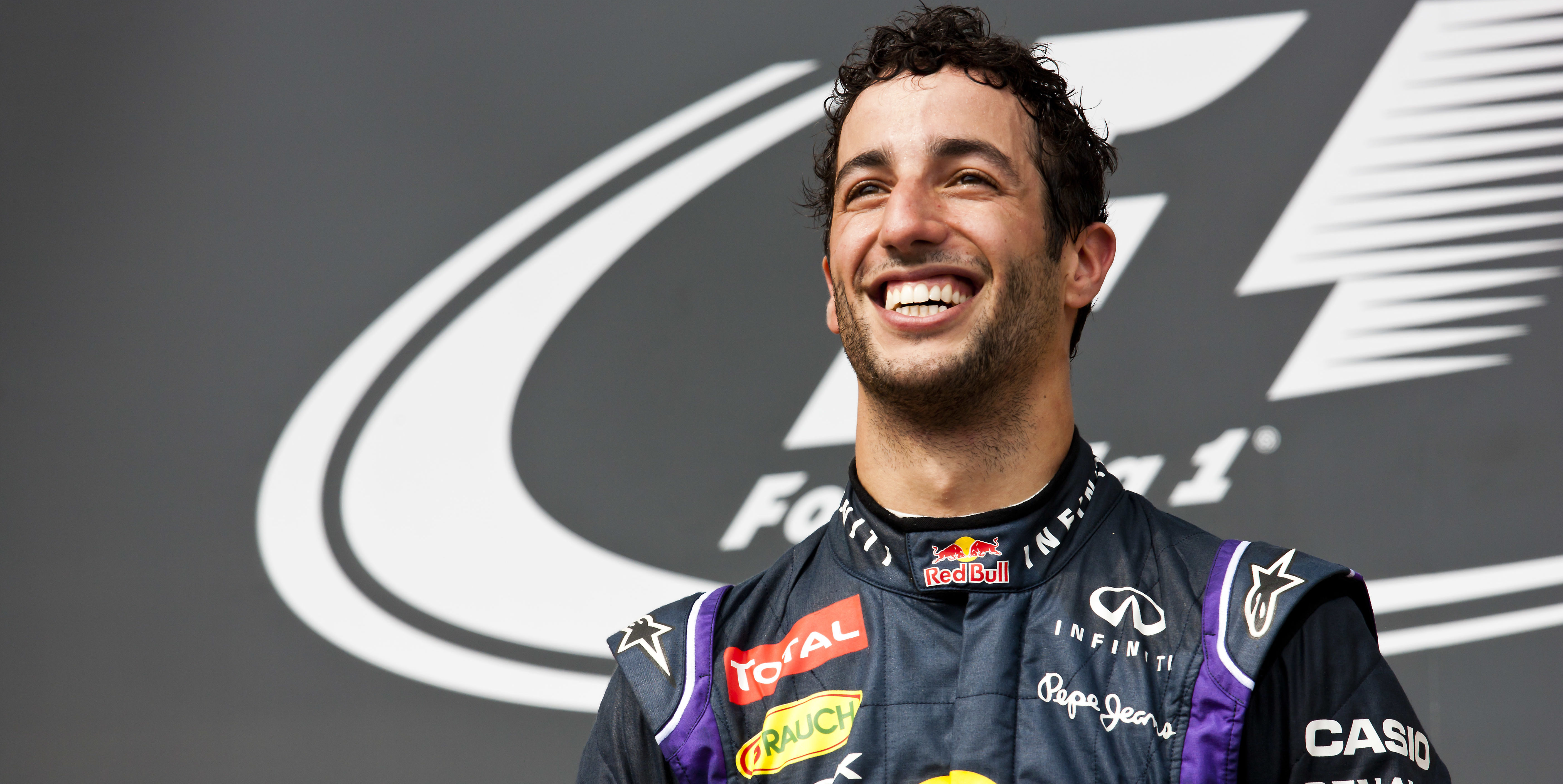

The Hungarian Grand Prix has been on the Formula 1 calendar since 1986 and the event has made a habit of delivering classic races, in spite of the circuit’s rather peculiar characteristics.
It’s difficult to know who to attribute the quote “Monaco without the walls” to – it’s a phase that is so commonly used to describe the narrow, twisty Hungaroring that it is bordering on being a cliche. However, in line with its prevalence, it does hold a glaring element of truth.
The Hungaroring is a short lap, with Sebastian Vettel’s 2017 pole time of 1m16.276s only four seconds longer than Kimi Raikkonen’s ‘17 Monaco effort. It is only behind Monaco and Singapore in having the lowest average speed on the F1 calendar.
An abundance of medium speed corners and short braking zones, when combined with these factors, should be a formula for mundane racing. The Hungaroring has the hallmarks of a venue in which drivers are destined to complain about the inability to follow other cars or race wheel-to-wheel.
While some Hungarian Grand Prix’s have met this expectation, recent history debunks the assumption that the circuit is not conducive to good racing.
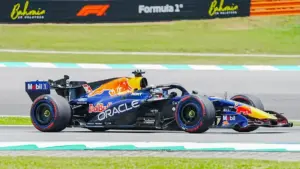
The most obvious example in recent times was served courtesy of Daniel Ricciardo during his first year at Red Bull. Ricciardo had already taken his first career victory with a late charge during the 2014 Canadian Grand Prix – his visit to Budapest later in the year would see a similar story play out, only this time in an even more dramatic fashion.
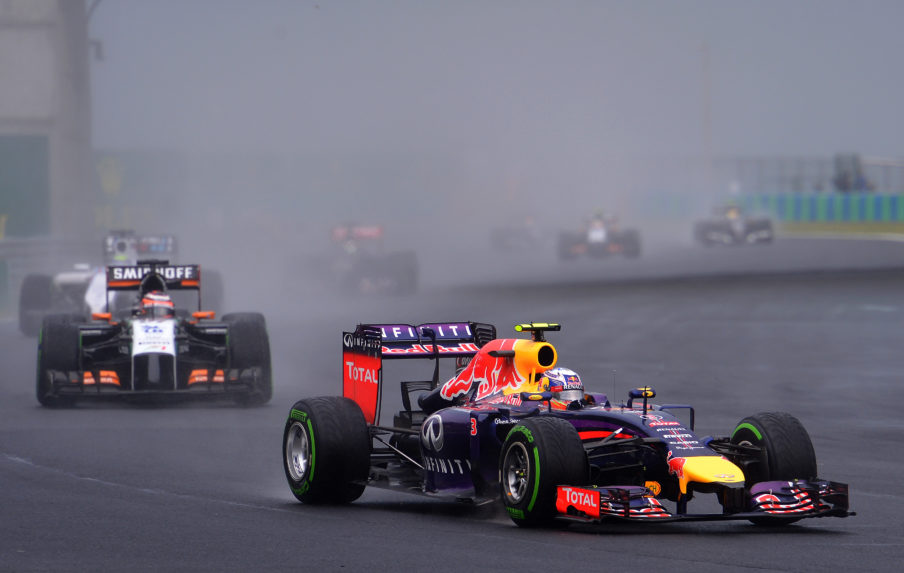
Ricciardo was sixth in the opening laps as the field was forced to deal with damp conditions as a result of heavy rainfall just 30 minutes before the start of the race.
When Marcus Ericsson lost control of his Caterham and hit the wall at the high speed right-hander Turn 3, the resulting safety car was deployed at a perfect time for Ricciardo – he was able to dive into the pitlane and gain track position over those ahead to lead the race at the restart.
Track position gained on a circuit likened to Monaco in terms of its characteristic – it sounds like the path to a comfortable victory. However, Ricciardo sacrificed the track position in favour of fresh tyres at the end of the race, emerging from the pits in third place behind Ferrari’s Fernando Alonso and Mercedes’ Lewis Hamilton.
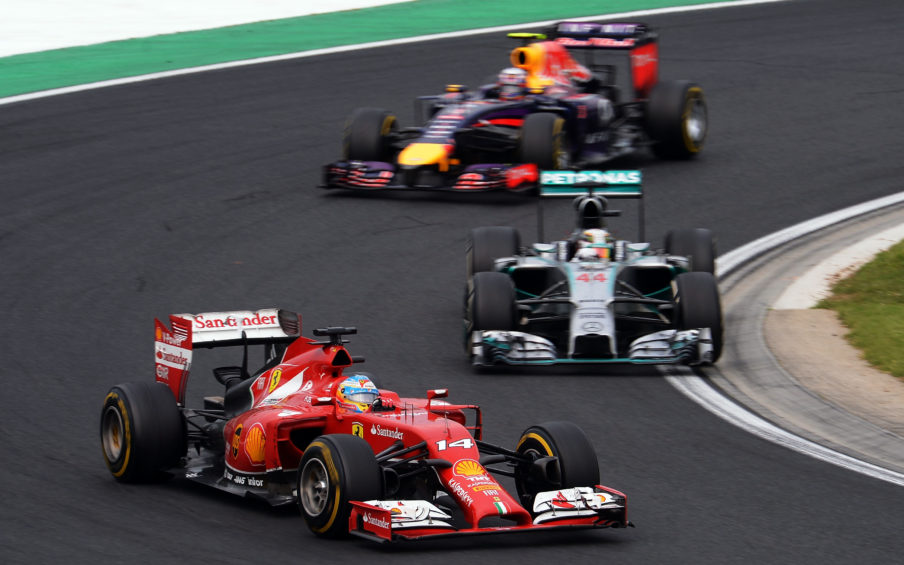
Ricciardo quickly closed in on the lead pair, catching Hamilton with eight laps remaining. Dispatching the Mercedes around the outside at Turn 2 with four laps to go, Ricciardo then dived to the inside of Alonso at Turn 1 on the next lap, grabbing the lead.
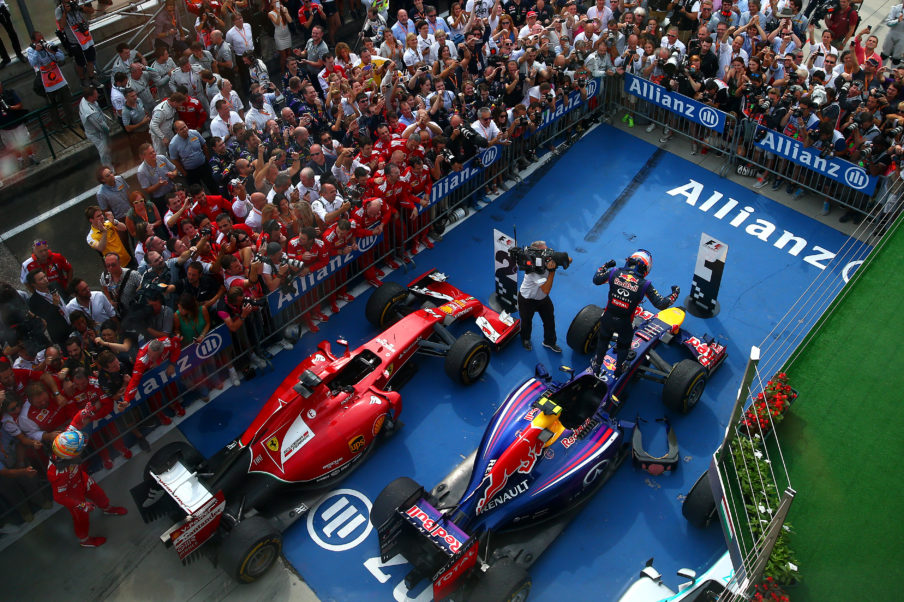
With Alonso and Hamilton’s heavily worn tyres consigning them to a rearguard action rather than counter-attack, Ricciardo scampered away to claim his second career victory in a race that showcased F1 at its best.
High tyre degradation opened up the opportunity for teams to roll the dice on strategy. To an extent, it also negated the effect of turbulent air – the performance disparity between new and old tyres was such that track position was well balanced with the benefit of fresh rubber.
Of course, the extent of degradation was, to a degree, facilitated by the pre-race rainfall which washed rubber off the circuit. It also enhanced the driving challenge posed by the Hungaroring, with kerbs retaining water and catching out both Sergio Perez and Sebastian Vettel while on the slick tyres.
Thunderstorms are forecasted for this weekend’s Hungarian Grand Prix, so the strategic and physical conundrums and perils that caused problems for the drivers in 2014 could make a reappearance.
The Hungaroring doesn’t necessarily need a sprinkling of rainfall to deliver an exciting spectacle, with the modern classics in 2013 and ‘15 perfectly demonstrating. However, with tyre degradation proving to less frequently induce strategic variance this year, rainfall could be the most effective way of the Hungaroring maintaining the tradition of delivering a compelling grand prix.
A positive tradition on a track which on paper, should consistently deliver processional races. Proof that you should never judge a book by its cover and also a testament to the unpredictability of motorsport.

Comments.
Loading comments…