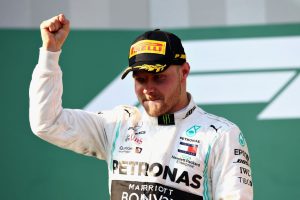
2013 was a brief snapshot of what 2014 was going to bring for the Brackley-based team: greater success, with the team having exceeded their expectations of last season, taking three race wins and nine podiums, especially the expectations of Lewis Hamilton’s first season with the team. All the recruitment and poaching of technical bosses and upheaval in management was always earmarked for 2014 and the new V6 turbo-charged hybrid engines making a introduction to the sport, the time Mercedes would see themselves as worthy championship contenders. Perhaps the final step towards the completion of the Silver Arrows project was team principal Ross Brawn leaving the team and handing the reins over to Toto Wolff and Paddy Lowe, joinly running the team as executive director (business) and executive director (technical) respectively in a management reform.
Early rumours of Mercedes’ power unit beng ahead of the rivals Renault and Ferrari concreted them being pre-2014 favourites and began to bear some truth in pre-season testing with their power unit proving its worth both on reliability and performance terms. Continuity was on their side with the team being the only team to retain both drives for the new season, while other teams have made one or wholesale changes to their driver lineups.
Their early advantage was growingly predictable, but the magnitude of their actual advantage was one very few could guess, particularly with wet weather in qualifying at the season-opener in Australia and in Malaysia masking their one-lap advantage over the rest of the field, while in the races they racked up 68 points out of a possible 86, including a 1-2 finish in the latter race and would’ve been a 1-2 finish in Australia as well had pole-sitter Hamilton not retired from an engine problem and their 25+ second race-winning gap would probably be bigger. The revealing and nadir of their advantage finally showed itself in Bahrain, with Mercedes locking out the front-row and Rosberg’s pole lap being almost a second faster than the closest non-Mercedes driver in Daniel Ricciardo, the race saw both Rosberg and Hamilton in a league of their own and battling for the win both intensely on-track and on different strategies until a safety car wiped away their substantial advantage, but restored a sizeable advantage afterwards with the drivers lapping over two seconds a lap faster than the rest of the field despite Rosberg and eventual race winner Hamilton dueling once again on-track and the latter on the slower tyre. Such their performance advantage, whatever challenge the powers-that-be on the pit wall had on managing their two drivers was eased by the freedom to let them race and not impose team orders as well as the distribution of data from either driver to the other, but were aware circumstances could change if their drivers found themselves in different positions, something that would become apparent later on in the season.
Their conquering of Bahrain was followed by two 1-2 finishes in China and Spain, with Hamilton converting pole to race wins on both occasions and taking the initiative in the championship ahead of Rosberg. Monaco saw the team enter new territory as it transpired that Rosberg and Hamilton illegally used unique engine settings to aid their race efforts in Bahrain and Spain respectively, this proved to be the foundation of the tension that grew when Rosberg took to the escape road on his final Q3 lap when topping the times and brought the yellow flags out, detering drivers, including team-mate Hamilton from putting in a quicker lap and therefore secured pole, which Rosberg went on to convert and take the championship lead back while Hamilton was left frustrated on the team radio after the team over-ruled his suggestion of pitting to get ahead of Rosberg with the risk of a safety car period looming after Adrian Sutil crashed out, that and his own suspicions of Rosberg’s off-track excursion in qualifying resulted in the Briton being subdued on the podium and friction growing between him and Rosberg as he declared post-race that they were no longer “friends” but “just colleagues” while Rosberg himself took a mild-mannered approach and insisted that they’ll always be friends. Suddenly, cracks began to form in the team and shadows of Ayrton Senna and Alain Prost’s tumultuous relationship at McLaren were about to make appearances, with non-executive chairman Niki Lauda and Wolff facing the challenging adversity of restoring at least a civil relationship between the two and managed so with Hamilton backtracking on his comments and said on social media that the pair put Monaco behind them and have been “friends for a long time and as friends we have our ups and downs”.
Dominant machinery in Formula 1 in the past have not been immune from the occasional or incesssant reliability troubles, and the Mercedes WO5 Hybrid is not an exception as proven with Hamilton’s misfiring cylinder in Australia and in Canada as the two cars, after another front-row lockout and race lead, experienced MGU-K failures which proved fatal to Hamilton’s brakes and forced him into retirement, while Rosberg limped home to second having to nurse his brakes and concede the race lead and win to Daniel Ricciardo in the Red Bull. The fact Rosberg crossed the line only 4 seconds behind Ricciardo with brake and power troubles, for over the remaining third of the race, again confirmed the enormity of the performance advantage that remained with Mercedes, but did reveal that through reliability hiccups that Mercedes were not impervious.
Another streak was to come to an end as Williams grabbed a shock pole and 1-2 on the grid, ending Mercedes’ run of pole positions with both Rosberg and Hamilton, who failed to put in a lap in Q3, having shortcomings with the car in qualifying, normal service did resume in the race as the two Mercedes drivers recovered to take a sixth 1-2 finish of the season with Rosberg leading Hamilton, albeit having Valtteri Bottas in 3rd just 8 seconds down the road, showing that Williams made life more difficult for the Silver Arrows on race day.
The first of two “home” races for the Brackley-based team saw the next stomping ground being Silverstone, but there were mixed emotions in the camp as home favourite Hamilton found himself in a lowly grid position after making another mistake in qualifying aborting his final Q3 lap and more or less handed pole to Rosberg. There would be mixed emotions on race day again as Rosberg retired from gearbox problems, while Hamilton quickly climbed through the field and inherited the race lead and eventual win from his team-mate. Another missed opportunity for Mercedes to build on their already major advantage in the constructors championship, and this would somewhat be the norm for the rest of the first half of the season as brake problems for Hamilton in qualifying at Hockenheim saw him having to recover ground once again on race day, while Rosberg achieved the feat Hamilton achieved two weeks prior and took top honours in his home race, with Hamilton 3rd instead of a likely 1-2 finish.
The change in circumstances with team orders came in Hungary when Hamilton found himself battling through the field after an engine fire ended his qualifying as soon as it started – and ahead of pole-sitter Rosberg, who lead from pole once again but was caught out by the safety car. Mercedes, knowing their drivers had found themselves battling other drivers for the lead on strategy, ordered Hamilton to let Rosberg pass for the sake of the latter, but Hamilton refused and cited giving away any kind of advantage to his championship rival and Rosberg not actually being close enough to effect a pass as the main reasons for not letting him by. Hamilton was proven correct as Mercedes came home 3rd and 4th, with Hamilton finishing just half a second ahead of Rosberg, who had much fresher tyres having pitted after not finding a way pass his team-mate, and so the Briton reduced the gap in the championship. Even team boss Wolff admitted that Hamilton was right in his defence and Mercedes were in a state of panic lacking the capacity to exploit their performance advantage as a result of the Hungaroring’s tight, narrow track nature not promoting overtaking opportunities.
Lewis Hamilton – 191 points/2nd in the Driver’s Championship
Hamilton moved to Mercedes with the strong belief that he would stand a much better chance of battling for championships from 2014 onwards, with 2013 somewhat being a transition and bedding-in year for him, and he hasn’t been disappointment by the tools at his disposal performance-wise.
Four wins on the bounce from Malaysia to Spain after an engine problem deprived him of the opportunity to convert his pole into a win in the opening race at Australia, including hard-fought wins in Bahrain and Spain when staring narrow defeat in the race with his team-mate Rosberg having tyre advantages sparked the thought of Hamilton being unbeateable and running away with the championship. However his inability to be more composed as he is faster than Rosberg over a single-lap, with Canada and Silverstone being two prime examples, is one of the two main reasons why he isn’t leading the championship, the other being most of the unreliability suffered by Mercedes falling on his side, mostly in qualifying at Hockenheim and Germany, where his form in practice would seem to imply likely pole positions were on the cards, and most costly in races in Australia and in Canada, both being massive setbacks to his championship aspirations.
The consistency in the reliability problems being predominantly on Hamilton’s car fueled conspiracies from his fans of Mercedes favouring a certain German driver in a German car for the championship, which Mercedes on social media and Lauda in the press have rubbished completely.
His combative, bold race craft that we’ve come accustomed to with the Briton in bygone seasons served him well when in damage-limitation mode in races such as Austria, Silverstone where a home win was inherited from his team-mate, and most notably in Hockenheim and Hungary. Unlike in qualifying, fewer, if any mistakes, have been committed by Hamilton on race day.
Peaks in the intensity of his championship battle have arised, with his post-race reaction in Monaco not bringing out the best of Hamilton in the wake of not having priority over race strategy, his team-mate’s controversial off-track excursion in qualifying and having to limp home to 2nd after problems with his vision during the latter parts of the race, and having to stand his ground (and rightfuly so) in Hungary as he defied a request from his team to let Rosberg through and paid off as he barely fended him off for 3rd in the end of the race, without the strategic advantage given earlier on.
As close as the championship fight, Hamilton could be depending on experience of battling for championships towards the business end of the season. As well as his speed advantage and supreme race craft displayed, providing the laws of averages come into play – he should be best placed to take his 2nd world championship.
Nico Rosberg – 202 points/1st in the Driver’s Championship
After leading a medicore Williams team for multiple seasons and beating a faded Michael Schumacher during their three-year tenure as team-mates in Mercedes, many saw Hamilton and the 2014 season as the strong indicators as where Rosberg exactly lies among the most elite drivers in the sport.
That’s why he should be seen as one of the revelations of this year, and despite enjoying the reliability his team-mate could only crave for during the first half of the season, it shouldn’t flatter the superior composure and decision-making over one-lap along with his highly-regarded dilligence he has shown to subside the extra few tenths Hamilton has over him, thus surprisingly taking six pole positions to his team-mate’s four, and has painted a picture of him being more consistent. His speed over a race distance has been more than enough to trouble Hamilton as proven in Bahrain and Spain, where he was just edged out for race victory, and having controlled proceedings and sustained constant pressure from Hamilton in Monaco after leading from a controversial pole position.
Reliability hasn’t been entirely in Rosberg’s favour as brake problems on both Mercedes in Canada saw him have to drive around the problems en route to 2nd, while his sole race retirement of the season so far came at Silverstone with a gearbox problem when leading.
The other two lights-to-flag wins in Australia and at home in Hockenheim were among the most comfortable and profitable, but also the demonstration of the intelligence Rosberg has of knowing the car he’s got underneath him and the ability to measure himself compared to others around him.
Mathematics have majorly been on Rosberg’s side since the opening race in Australia, but the worry for him is if Hamilton both eradicates his mistakes and experiences better reliability in qualifying and is in a position with his greater speed to build a similar, if not longer winning streak like earlier in the season. What weapons in his arsenal does Rosberg have to combat that? Especially with Mercedes deciding to be strict with alternative race strategies now. There’s the fact with retirements aside that he’s actually only beaten Hamilton on merit once this season. Heading into the second half of the season is something of new territory for the German as he hasn’t been in a battle this close, let alone for a world championship, in his career so far. The consistency and mental strength he has shown this season so far is elusive for the remaining eight races.
Race Results so far:
[table id=9 /]
Performance Comparison so far:
[table id=10 /]
It’s a matter of “when” rather than “if” Mercedes will wrap up the constructors championship, but the drivers championship (and the pole position trophy too) between their two drivers is anything but that and is a completely unique story in its own right, one of them could find themselves pinning hopes on the double points race in Abu Dhabi. Winning the remaining eight races is something that’s feastible if Mercedes can replicate their enormous performance advantage and the racing gods do’t tinker with the reliability of their machinery. Both Hamilton and Rosberg are at least civil for now if not “friends” like they’ve declared post-Monaco, will peace in the camp be disrupted again? Will there come a time again where experts will think Ross Brawn’s presence on the pit-wal is missed? Or will the likes of Toto Wollf, Niki Lauda and Paddy Lowe enjoy some respite from dealing with driver friction? Time will tell, and the beginning of the end of a tantalisingly close inter-team battle begins at Spa on Friday.